
13 years ago, Sapphire’s Glide-On™ system changed the way the construction industry looked at balcony installation.
It took us from the era of complicated, on-site manufactured concrete balconies into the age of fully prefabricated, off-site manufactured aluminium balconies.
Glide-On™ quickly became the new standard for balcony installation. But it was far from a perfect system.
Over the following decade, we started to notice the same familiar constraints across sites working with Glide-On™: protruding arms interfering with scaffolding; operatives working at height; installation sequences slowing programmes down.
It was clear there was work left to do – and questions left to answer.
Questions like:
This would mean there would be no need for arms protruding from the façade, meaning no interference with scaffolding. It would mean no need for an installation phase to install the arms, which would accelerate programmes.
But it would also mean the arms would need to be connected to the stub at the point of installation – which could be dangerous for operatives.
Then again, we wondered, what if we didn’t need an operative working at height? What if the arms could be connected to the stubs autonomously?
Say… by a robot?
This led us to develop the Remote Locker Device (RLD) – a machine that allows balcony arms to be locked in place remotely, at the point of installation, with minimal on‑site intervention. The system is patent-protected, reflecting a fundamentally different approach to how balcony arms are connected to the structure. By enabling the connection to be completed remotely, with the arms pre-installed inside the cassette, it removes the need for traditional on-site fixing methods and working at height during critical stages.
In literal terms, the Remote Locker Device (RLD) is a small, battery-powered robotic device, roughly the size of a toolbox, that allows installers to lock the balcony arms inside the cassette onto the stubs using a radio controller.


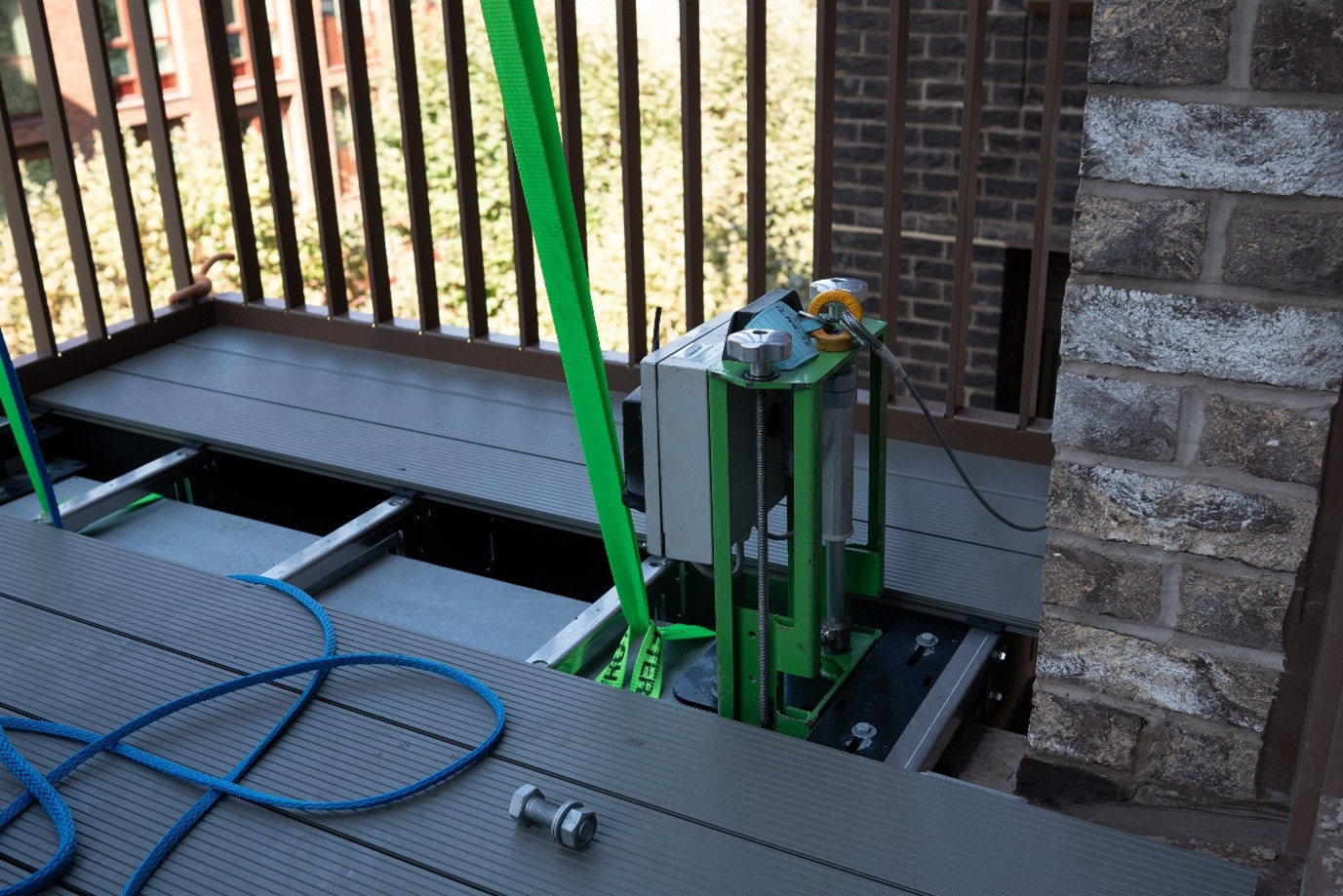

The operative can perform most of the balcony installation from inside the apartment. Standing behind a safety barrier, they guide the balcony onto the stubs using an elongated hook. Once the RLD is in place, the operative presses a button to secure a pin in place. The RLD tightens the connection, then performs a robust safety check and signals the operative when the balcony is secure. The operative can then safely walk on the structure to perform the finishing touches, such as attaching the final decking slats.
When the operative is finished, they simply remove the RLD, ready for it to be reused on the next installation. Just like that, the balcony is finished – there’s no need for further installation phases, and the next installation can proceed.
When we talk about the RLD, we’re not referring to the so-called ‘green machine’ itself. Because the RLD is more than just a device – it’s a complete system.
That systems begins when the balcony anchors are first cast onto the façade, and when the balcony itself is under construction in our factory.
Unlike our Glide-On™ system, which required three installation phases (one to cast in the stubs and anchors, one to attach the arms, and one to glide on the balcony), the RLD system requires only two installation phases. Because the arms are pre-installed inside the balcony, there’s no need for a phase to attach the arms. That not only frees up a line in your programme, it ensures balcony sites won’t interfere with scaffolding.
The rest of the balcony is pre-finished in the factory, so it arrives on site ready to install with soffits, balustrades and handrails already fitted. The decking is also mostly finished, except for a few slats (which are left off so that the RLD can be attached).
The RLD promises to accelerate balcony installation like never before. With a lower risk of delay, less manual handling and fewer snagging issues, the RLD’s benefits can be measured in direct return on investment.
More importantly, the RLD benefits site safety. With the RLD system, operatives do not need work at height on an unsecured structure – in fact, the first time an installer interfaces with the balcony will be after the RLD has secured it in place and confirmed the structure as safe.
Operatives will also not need to work underneath the balcony, and the faster overall installation speed mitigates the risk of balcony back up.
The RLD system works across all frame and façade types, solving the universal problems of quality, speed and safety. It provides a streamlined approach to sequencing that can eliminate bumps in your programme and helps ensure a fast, effective balcony installation. It improves performance on tight and physically constrained sites. And it provides the quality you have come to expect from Sapphire: a stable, secure connection and a balcony unit that’s built to stand the test of time.


On a fast-moving urban site in North-West London, our Remote Locker Device proved it can not only meet ambitious delivery targets at speed and scale while maintaining site safety, it can also be engineered to work in parallel with complex panelised façade installations to ensure minimal disruption, achieve perfect threshold detailing and deliver attractive homes.
The Remote Locker Device is our biggest innovation in a decade and promises to set the industry benchmark once again.
We’re proud to be delivering this innovation, and we’re excited to see what the future of balcony installation will look like. We believe the impact of the RLD will dwarf even that of our Glide-On™ system.
Right now, Sapphire is already delivering and installing balconies across the country using the RLD and seeing incredible results – faster, safer and more efficient deliveries. If you’d like to know more about how the RLD system could benefit your project, don’t hesitate to speak to us today.