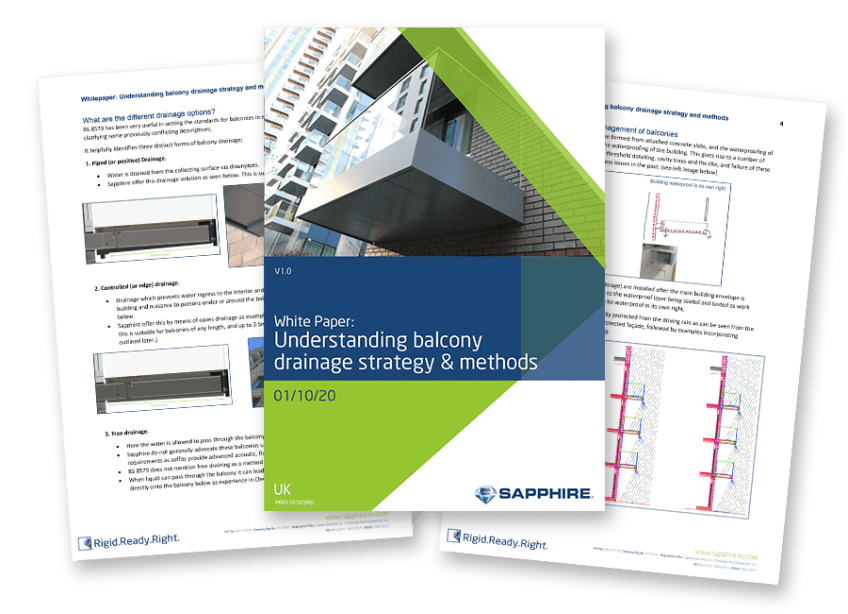
This balcony drainage whitepaper is intended to give an overview of the design philosophy behind the Sapphire drainage options, as an aid to correct specification.
Traditionally, roofs and the like in excess of 6m2 have been required to have positive drainage, primarily due to the accumulation of water runoff at one point, which can provide nuisance and lead to pattern staining.
Positive drainage has also lead to a crisis in New Zealand. The leaky homes crisis in New Zealand was estimated in 2009 to have incurred costs of approximately $11.3 billion and is still ongoing. This construction and legal crisis affected timber-framed buildings built from 1994 – 2004 which suffered from issues with their weather-tightness and drainage.
Over the past decade, Sapphire have pioneered the concept of dividing the soffits on longer balconies into smaller sections so the runoff is evenly dispersed along the length of the balcony. This design has been successfully adopted in many projects throughout UK and Ireland, in projects up to 30 stories.
The concept has also been endorsed by the BS 8579 committee and incorporated in the new standard for balconies of any length, and up to 2500 mm projection.
Within this paper we will also explore the drainage options for balconies and key considerations to be aware of when specifying.
Download the drainage whitepaper to continue reading.

What’s included in the Barrier Height whitepaper? In an era where balcony safety and usability are under sharper scrutiny,…